We all have that one friend. The one who polished off an entire plate of chicken rice and a side of wings, yet somehow stays lean year-round. You look at your own plate, then back at them, and think: "Is my metabolism actually broken?"
The short answer is no. Your metabolism is not broken, and it is not a character flaw. It is a system governed by biology and maths. Once you see how it actually works, you will understand exactly why your friend stays lean, why your fat loss feels stuck, and what to do about both.
What your metabolism actually is
Your metabolism is your Total Daily Energy Expenditure, or TDEE: the total energy your body burns in 24 hours. Most people picture their workout when they hear "calorie burn", but the workout is only one small slice. Your TDEE has four parts, and by the end of this section you should be able to answer, with confidence, exactly what happens to the extra calories you eat: some are spent by your body's background work, some by digestion, some by your workout, and the rest depends almost entirely on how much you move around. Here they are, biggest lever first.
 Figure adapted from Trexler ET, Smith-Ryan AE, Norton LE. Metabolic adaptation to weight loss: implications for the athlete. Journal of the International Society of Sports Nutrition, 2014;11:7.
Basal Metabolic Rate (BMR), roughly 60 to 70%. The energy your body burns keeping you alive: your brain, heart, liver, kidneys, all running 24/7. This is the workhorse of your metabolism, and here is the part that matters for your jeans size: muscle is metabolically active tissue. Research estimates each kilogram of muscle burns about 13 calories a day at rest, while a kilogram of fat burns about 4.5 (Elia, 1992). Not a huge gap per kilo, but muscle wins three ways. It burns more at rest, it burns plenty more while you use it, and crucially, it changes what happens to your food: roughly 80% of the glucose your body clears from the bloodstream after a meal is taken up by skeletal muscle (DeFronzo and colleagues). So when people say muscle "raises your metabolism", the fuller, more honest picture is that muscle raises your BMR AND decides where much of your food goes. A bigger, well-trained muscle system acts like a bigger engine with a bigger fuel tank: more of each meal gets used and stored as accessible muscle fuel instead of drifting into fat storage. That is why strength training is the closest thing to a genuine "metabolism boost" that actually exists.
Thermic Effect of Food (TEF), roughly 10%. Digestion costs energy; think of it as the taxman taking his cut of every meal. And the tax is not flat: protein costs your body 20 to 30% of its own calories to process, versus about 5 to 10% for carbs and close to zero for fat. This is one quiet reason higher-protein diets outperform: you literally burn more of the meal just handling it.
Exercise Activity Thermogenesis (EAT), typically 5 to 10%. Your actual workout. Notice how small this is. A hard 45-minute session might burn 300 to 500 calories, which one prata breakfast can quietly replace. This is why "I exercised today" and "I created a calorie deficit" are two very different sentences.
Non-Exercise Activity Thermogenesis (NEAT), roughly 15 to 30%, and wildly variable. Every calorie you burn moving around outside a workout: walking to the MRT, pacing on phone calls, cleaning the house, carrying groceries, fidgeting, taking the stairs.
Why NEAT decides your results
Look at those four parts again. BMR is the workhorse, TEF is the taxman, and EAT is a small, capped slice. NEAT is the swing factor. Research from the Mayo Clinic has found NEAT can vary by up to 2,000 calories a day between two people of the same size (Levine, Mayo Clinic Proceedings, 2004). Two thousand. That is an entire day of eating, decided by how much you simply move around.
In the same group's famous overfeeding study, participants were fed 1,000 extra calories a day while keeping exercise identical. Some gained weight steadily. Others gained far less, and the difference was a 10-fold spread in fat gain that changes in NEAT directly explained (Levine, Eberhardt and Jensen, Science, 1999). Their bodies unconsciously ramped up background movement: more pacing, more standing, more fidgeting. Their movement habits quietly absorbed the surplus.
Here is the frustrating part for gym-goers: when people start an intense exercise regime, NEAT often drops. The body is smart; if it feels it has "worked hard" at the gym, it subconsciously encourages you to be more sedentary the rest of the day to conserve energy. You take the lift instead of the stairs, you slump at your desk longer, you skip the evening walk because you have "earned a rest". The result: your gym gains get quietly cancelled out. This is the most common reason someone trains hard and the scale refuses to move.
So why is your friend lean?
Back to the chicken rice friend. When researchers put lean and heavier people in controlled settings, the differences in "metabolism" mostly evaporated. What differed was two trainable things.
One: movement you cannot see. Your friend almost certainly walks more, takes stairs without thinking, and fidgets through meetings. In the overfeeding study above, the high-NEAT participants ate a thousand extra calories a day and gained almost nothing. Of course, if they ate entire tubs of ice cream nightly, staying lean would be unlikely, not impossible. But within normal eating, their background movement quietly handled the extra wings.
Two: the size of the engine. Your friend likely carries more muscle and trains for it. That means a higher BMR burning in the background, plus better glucose handling: a big plate of rice gets absorbed into muscle stores instead of settling around the waist. Their body is not magic; it is a bigger machine that processes the same food differently.
Neither of these is a genetic gift you missed out on. Both are built. That is the best news in this entire article.
The Singapore NEAT playbook
You cannot willpower your way into more NEAT; you design it in, the same way you design any habit. This is exactly how we coach it:
Take the stairs. Especially in a high-rise city. If you work on the 12th floor, take the lift to 9 and walk the last three. Nobody needs to start with 12.
Walk the longer lunch. Pick the hawker centre one street further away. You will add 2,000 steps a week without ever "doing cardio".
Alight one stop early. One MRT stop before your office, every day, both ways. It is the cheapest gym membership in Singapore.
Stand more. If you have a standing desk, use it. If not, stand up every 30 minutes, and pace during phone calls. Calls are free walking time.
Track a floor, not a ceiling. Aim for 6,000 steps a day to start, and let 10,000 come later. A baseline you actually hit beats a target you quietly abandon.
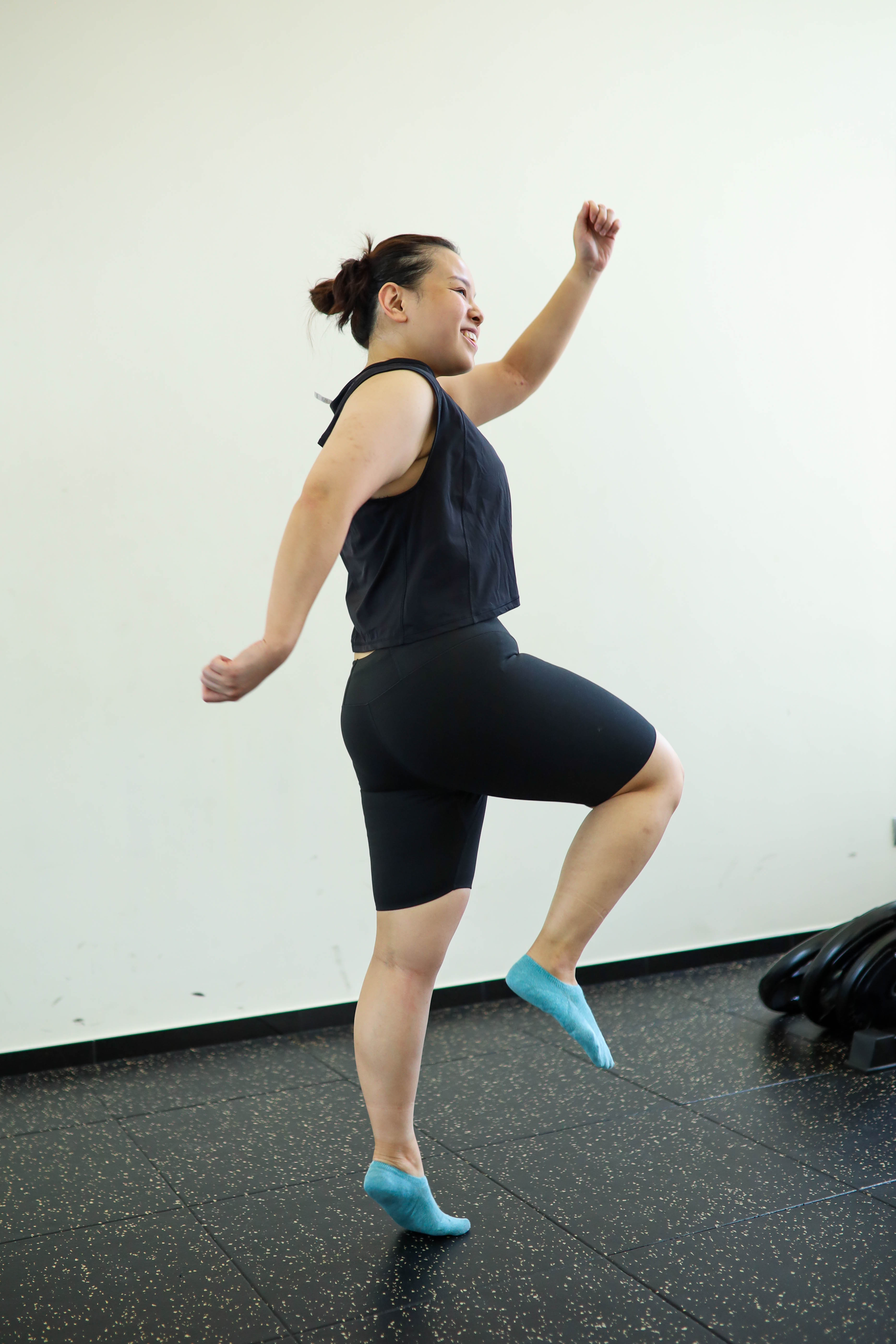
Then stack the other side of the equation: strength training to raise your BMR and give glucose somewhere to go, and enough protein to keep the TEF taxman working in your favour. NEAT, muscle and protein together are what a functioning metabolism actually looks like.
Take this article with a pinch of salt (yes, really)
Before you take everything above as gospel, a word from your coach. Every study cited here describes averages from controlled settings. Your body is far more complex than a four-part pie chart: hormones, genetics, sleep, stress, age and medical history all shift the maths in ways no research paper can predict for you specifically.
And the data itself has a problem: people say one thing and do another, and worse, they often genuinely do not realise. In a classic New England Journal of Medicine study, participants reported eating under 1,200 calories a day while objective measurement showed nearly double that, and they also overestimated how much they moved (Lichtman et al., 1992). They were not lying. They simply did not know what they were actually doing.
We see the same in real life. One of our coaches trains just 20 minutes a day, three times a week, and holds a lean physique of around 12% body fat all year round. Meanwhile, a female client who trains three times a week for a full 60 minutes was stuck at 25% body fat. On paper, she trains three times more than he does. But his 23 hours, his muscle built over years, and his honest eating do the quiet work. The workout is the smallest slice, and effort in the gym is not the same as outcome out of it.
So use this article as a starting map, not a verdict. What we teach here is suitable for general fitness, and it works for the vast majority of people. But if you have genuinely done all of this and your progress still stalls, you have outgrown general advice. The next level requires a deeper, individual understanding of your own body: your actual intake, your actual output, your training history and your hormones. Nobody finds that in an article, and that is precisely what real coaching is for.
The 23 hours we actually coach
Anyone can train you for one hour. But fat loss is decided in the other 23, and that is where our coaching lives: building muscle that raises your BMR, a food accountability system that keeps the intake side honest, and movement habits folded into your real Singapore routine, not a fantasy schedule. If your progress feels stuck despite consistent training, it is usually not your metabolism. It is that nobody has ever coached your NEAT. Book a free consultation and we will show you exactly where your 23 hours are leaking.
References
- Trexler ET, Smith-Ryan AE, Norton LE. Metabolic adaptation to weight loss: implications for the athlete. Journal of the International Society of Sports Nutrition, 2014;11:7. (TDEE breakdown figure)
- Levine JA, Eberhardt NL, Jensen MD. Role of nonexercise activity thermogenesis in resistance to fat gain in humans. Science, 1999;283(5399):212-214. (pubmed.ncbi.nlm.nih.gov/9880251)
- Levine JA. Non-Exercise Activity Thermogenesis in Obesity Management. Mayo Clinic Proceedings, 2004. (The wide range of NEAT between individuals and its role in resistance to fat gain.)
- Elia M. Energy metabolism: tissue determinants and cellular corollaries. Raven Press, 1992. (Specific metabolic rates of body tissues: skeletal muscle about 13 kcal/kg/day versus adipose tissue about 4.5 kcal/kg/day.)
- DeFronzo RA, et al. Skeletal muscle accounts for approximately 80% of insulin-stimulated glucose disposal. Diabetes and related reviews, 1985 onward.
- Lichtman SW, et al. Discrepancy between self-reported and actual caloric intake and exercise in obese subjects. New England Journal of Medicine, 1992;327(27):1893-1898. (pubmed.ncbi.nlm.nih.gov/1454084)