Singapore has one of the world's greatest food environments, and that is exactly the problem. Makan is culture, family, business meetings, celebrations. There is a hawker centre within walking distance of almost every office, a birthday cake in the pantry most weeks, and a client dinner on the calendar before the week is out. Nobody should have to eat "differently" to get results, and at JG Fit we don't ask you to. Our whole approach, the one behind our free guide Navigating Singapore Makan, is to help you choose better from the food you already know and love.
That distinction matters, because the usual advice ("eat clean", "cut carbs", "avoid fried food") falls apart at the exact moment you are standing in a queue at the hawker centre at 12.30pm. What survives contact with a real Singapore week is a short set of filters you can run in ten seconds, in any environment, without a food scale or an app.
Three filters that work anywhere
Every environment, from hawker centre to hotel buffet, gets easier when you run the same three checks:
-
Protein first. Anchor the meal around a palm-sized portion of protein and the rest of the plate usually takes care of itself. A palm-sized serving is roughly 20 to 30g of protein. Protein is the most satiating macronutrient, so it keeps you fuller for longer, it protects muscle while you lose fat, and it makes overeating much harder. It also carries the highest digestive cost of any macronutrient, burning roughly 20 to 30% of its own calories just to be processed.
-
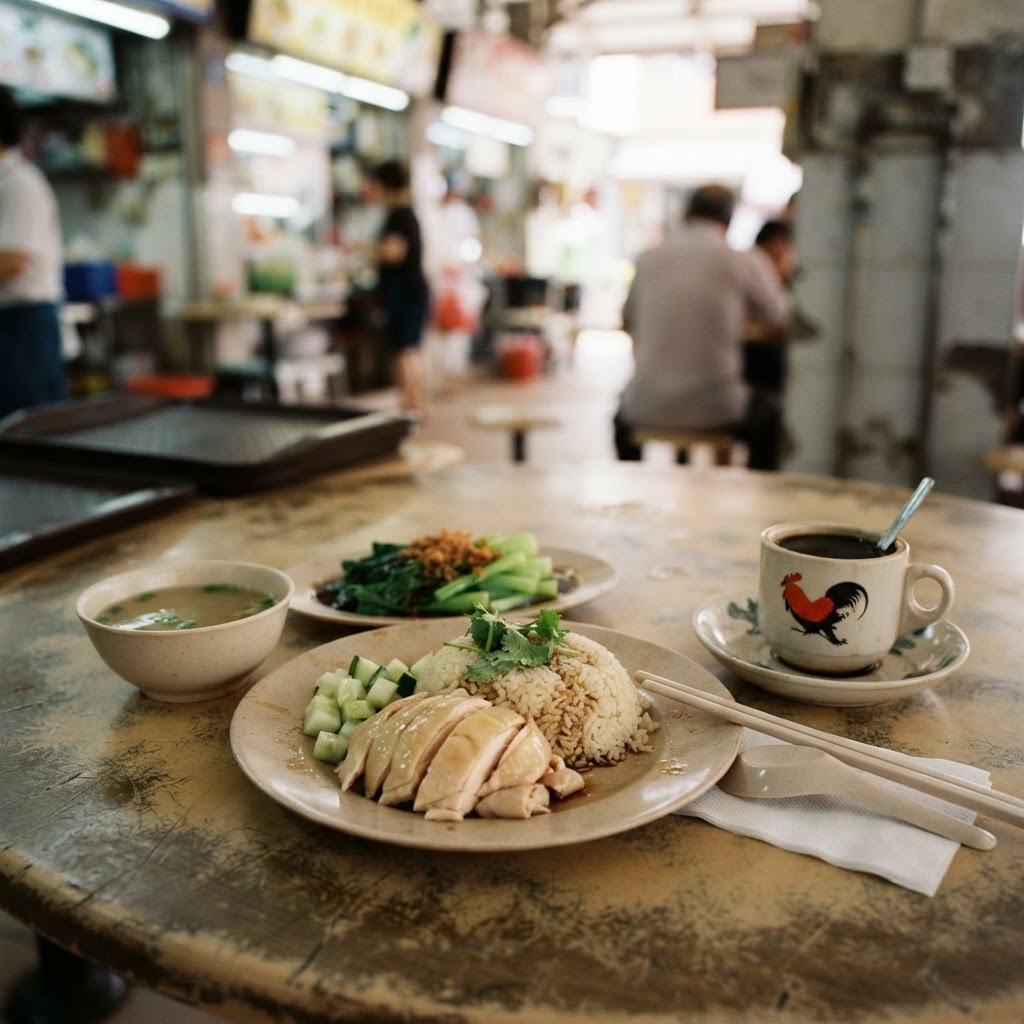
Go easy on sauce, batter and fried. This is the single biggest lever at any stall. Sauce on the side, grilled over fried, soup over gravy. It costs you nothing in enjoyment and saves hundreds of calories a week. Chicken rice is the clearest example: HPB's own HealthHub figures put a plate at around 635 calories, and the sauce, the skin and the oil in the rice are most of the distance between that and a grilled chicken with rice.
-
Half the plate volume from vegetables. Not because carbs are evil, they aren't. Vegetables add volume, fibre and micronutrients, so you finish satisfied instead of still hungry, on fewer calories. Half the volume, not half the weight: a mountain of kai lan takes up a lot of stomach space for very little energy.
The environment playbook
Hawker centre or food court. The easiest place in Singapore to eat well once you know the stalls. Chicken rice with the sauce on the side plus extra greens, fish soup with vegetables and rice, yong tau foo loaded with vegetables, tofu and egg, ban mian with extra greens, nasi padang with two vegetables and one meat instead of the usual ratio. Your usual stall probably has a better option two steps from the one you order by default, and asking for less rice or more vegetables is usually free.
Restaurants. Order the protein main, ask for sauce on the side, and make the vegetable side an actual side, not a garnish. Korean and Japanese sets are naturally structured for this: grilled meat, rice, soup, vegetables. The set is a plate with the filters already built in.
Buffets and celebrations. This is a portion event, not a restriction event. One plate, protein and vegetables first, then choose the two things actually worth having, eat them slowly and enjoy them fully. One indulgent meal has never ruined anyone's progress. The week after it does, if you treat it as the new normal.
Coffee shop breakfasts. A kopi with condensed milk runs roughly 110 to 135 calories, while a kopi O kosong is closer to 10. So kopi O siu dai, black coffee with less sugar, is an easy way to take 50 to 100 calories off a drink you were going to have anyway. And if it's a kaya toast morning, add the eggs for protein and make the toast the smaller part, not the whole meal.
Convenience stores and airports. The travel rule is protein wherever you can find it: boiled eggs, Greek yogurt, a grilled chicken sandwich over a pastry. A "good enough" choice on the road beats an "all or nothing" one every time.
Office pantry and meetings. The fix is environmental, the same way we coach around NEAT. If the biscuits are three steps from your desk, you'll eat them on a stressful Tuesday, no matter how disciplined you felt on Monday. Keep a protein option in the fridge and let that be the path of least resistance. Change the environment and you stop relying on willpower.
Swaps that cost nothing. Two vegetables and one meat at the cai fan stall instead of three meats. Sauce on the side instead of poured over. Soup instead of gravy. Grilled instead of fried. Less rice, more greens. None of these ask anything of your willpower at the table, which is exactly why they hold up over months rather than days.
Which level are you eating at?
In our guide, we group nutrition understanding into three levels. Level 1, starting out: your only job is protein at breakfast, lunch and dinner. That is the whole assignment, and for most people it is enough for several weeks. Level 2, learning the basics: start noticing how food actually makes you feel, energy, fullness, sleep, the difference between a lunch that carries you to 4pm and one that puts you under the table by 2.30. Level 3, advancing: you can eyeball a plate and flex your choices without tracking anything.
Most people are at Level 1, and that is completely fine. The point is knowing your next step, not being perfect. The full breakdown, with stall by stall picks, is in Navigating Singapore Makan, which is free: get the guide.

When you slip, the pivot is the skill
Everyone slips. A wedding dinner, a work trip, a week where the only meals you didn't skip were the ones eaten standing up. None of that is a verdict on your discipline, and none of it needs penance.
The skill is the pivot: the next meal returns to baseline. No skipped meal to "make up for it", no punishment cardio, no waiting for Monday to restart. People who get results are not the ones who never have a heavy weekend. They are the ones who are back to a normal plate by Monday breakfast instead of Monday next month.
Quick answers
Is white rice off limits? No. Rice is fine, and it is the base of most meals in Singapore. The filters still apply: put protein and vegetables around it, watch the sauce and the oil it was cooked in, and adjust the portion to your goals rather than cutting the food group entirely.
Do I need to track calories to do this? No. At Level 1 and Level 2 you are working with structure, not numbers. Tracking is a useful tool later if you want precision, and it is optional, not a prerequisite.
Can I really eat well at a buffet or a zi char dinner? Yes, with a sequence. Protein and vegetables first, one plate, then choose the two dishes genuinely worth the calories. What breaks progress is not the buffet, it is treating the days around it as a write off.
If you want this chosen for you, meal by meal, that's what our food accountability coaching does: you send us what you're eating, we help you adjust in real time and build the habits until you no longer need us. Book a free consultation and we'll meet you exactly where you are.


